






Abbaye Royale de Fontevraud
Musée Maurice Dufresne
Musée Balzac
Musée des Beaux-Arts
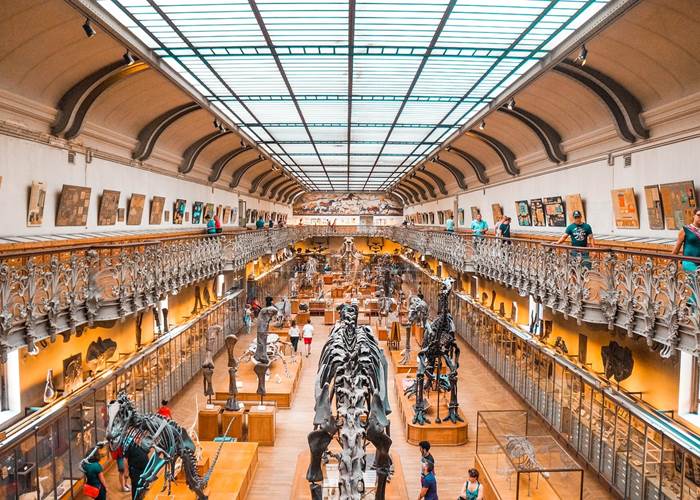
Muséum d'Histoire Naturelle
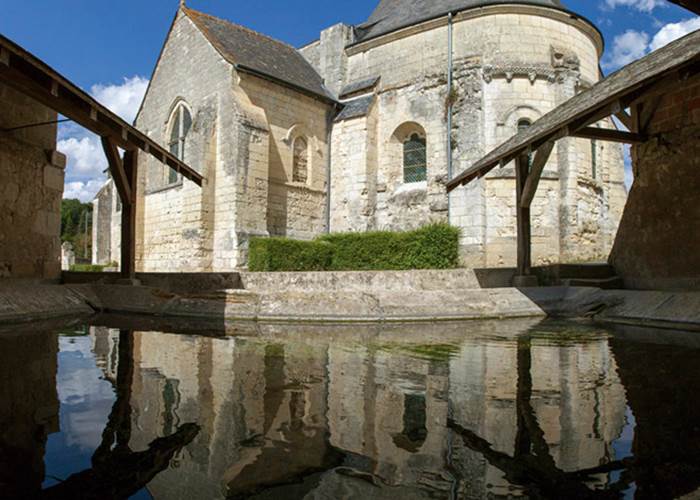
Sanctuaire Carolingien
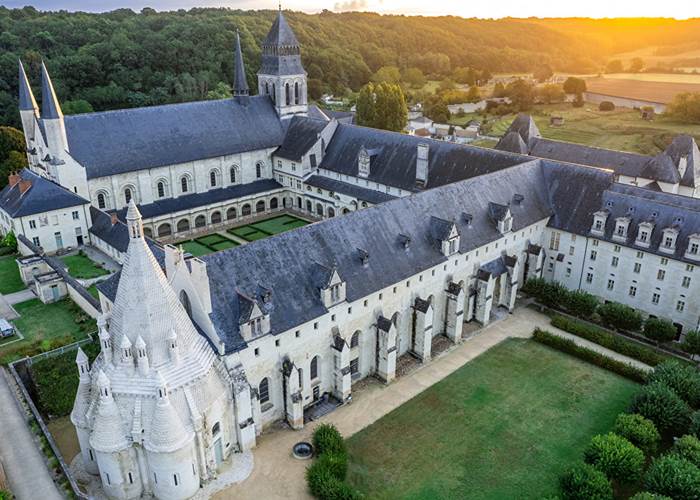
Royal Abbey of Fontevraud
The Royal Abbey of Fontevraud is one of the largest monastic complexes in Europe, located in the Loire Valley. Founded in 1101 by Robert of Arbrissel, it played an important role in the religious and political history of France.
In its early days, the abbey was a double monastery, housing both monks and nuns, and headed by an abbess. The rules of life were strict and based on Benedictine monastic discipline.
Fontevraud Abbey prospered over the centuries, supported by donations from the nobility and royalty. It also benefited from the patronage of the Plantagenet dynasty. Indeed, the tombs of several members of this family can be seen there, including Henry II of England, Eleanor of Aquitaine, Richard the Lionheart, and Isabella of Angoulême.
Over time, the abbey was enlarged and embellished. The buildings include an abbey church, cloisters, dormitories, kitchens and other monastic structures.
After the French Revolution, Fontevraud Abbey was closed and converted into a prison. This penitentiary function lasted until 1963. The abbey was then classified as a historical monument and underwent significant restoration work.
Did you know that?
36 abbesses succeeded one another at the head of the abbey until 1792, a unique situation in history!
Royal Abbey of Saint Pierre de Bourgueil
The interior of the monastery, renovated in the 18th century, is particularly elegant, with its large, restored monks' refectory, its drawing room paneled with its original woodwork, and its monumental suspended staircase. The former 14th-century cellars, partially converted into a chapel in the 19th century, now host exhibitions of visual arts. The abbot's palace, the residence of the commendatory abbot, is a beautiful and imposing building, rebuilt in the 17th century and modified in the 19th century. A 17th-century bridge spans a waterway, allowing us to visualize the layout of the gardens up to the Revolution.
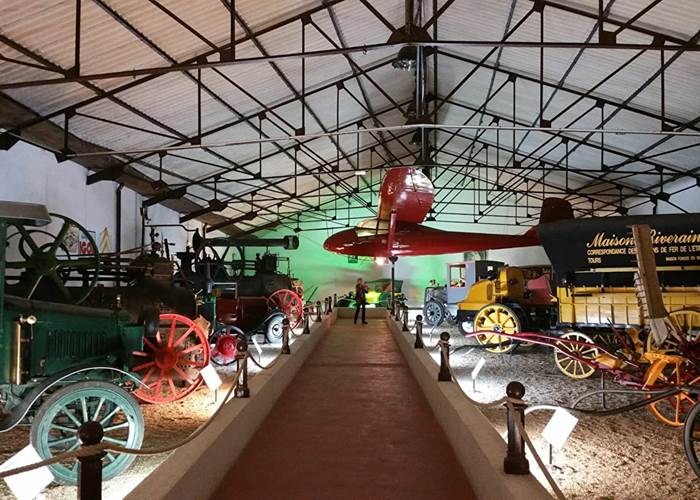
Maurice Dufresne Museum in Azay-le-Rideau
Located in the heart of the Centre-Val-de-Loire region, in Azay-le-Rideau, the Cité RétroMécanique – Parc & Collection Maurice Dufresne houses an impressive collection of vintage vehicles, including cars, bicycles, airplanes, trucks, motorcycles, tractors, agricultural and military machinery, vintage posters, and unusual period objects. A unique retro-mechanical heritage spanning the 1850s to the 1950s!
Nearly 3 hours of visit and a journey through time, family and intergenerational, to discover more than 3000 exceptional inventions and for many of them, unique in the world.
Rabelais Museum in Seuilly
Rabelais used his house, "La Devinière," and the surrounding landscape as the natural setting for the adventures of his giants. The collections of rare editions, antique engravings, illustrated books, portraits, and temporary exhibitions shed light on the new ideas of the Renaissance. The garden, orchard, and vineyards that surround it offer a moment of relaxation after visiting this rural museum.
Carolingian Sanctuary at Cravant-les-Coteaux
The sanctuary, some elements of which date back to the 7th century, is one of the most interesting in the Loire Valley and its nave remains one of the few well-preserved examples of Carolingian cultural architecture.
Its mural paintings, emanating from 6 campaigns superimposed over time, and the Romanesque elements of its transept and choir, bear witness to artisanal practices whose simplicity is moving.
Nestled in the heart of the Loire-Anjou-Touraine Regional Natural Park, surrounded by vineyards, historic manor houses and shaded paths, the Cravant Sanctuary offers an ideal setting for nature and heritage lovers.
Museum of Prehistory in Grand-Pressigny
With its rich collections and its status as a "Musée de France" (Museum of France), it is an iconic site of French prehistory and a unique resource center for flint tools. Discover the daily life of master flint knappers through its extensive collections, fire-making demonstrations, and fun workshops.
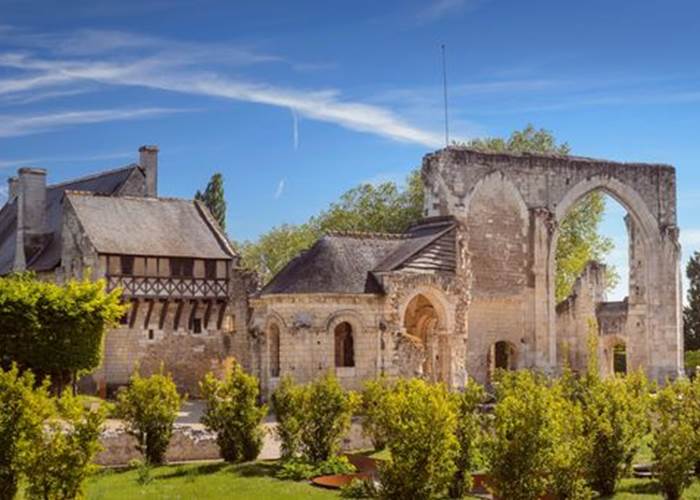
Balzac Museum in Saché
Discover the Château de Saché, a place of regular stays for Honoré de Balzac in Touraine. A witness to a long history, its Renaissance architecture bears the discreet marks of its medieval construction and successive alterations which express a romantic atmosphere since the 19th century. Its two-hectare park invites contemplation of the surrounding landscapes, from the village of Saché to the Indre valley.
The Priory of St. Cosme - Ronsard's residence in La Riche
Immerse yourself in the world of Ronsard's work through an original and interactive experience. The prior's residence evokes the poet's life and the richness of his oeuvre. The story continues in the gardens, which reveal Ronsard's love of botany, gardening, and flowers.
Natural History Museum in Tours
Located at the gates of old Tours, the Museum of Tours offers four spaces to discover:
Temporary exhibition : On the ground floor, the Museum is currently presenting an exhibition entitled "Along the water, the aquatic animals of Touraine".
Vivarium : (currently closed for renovations) On the first floor, the vivarium contains snakes, lizards, turtles, fish, amphibians and insects in recreated biotopes with the aim of raising awareness about these species.
Natural history collections : On the second floor, observe up close taxidermied animals from all over the world as well as various rocks.
Library : Located on the third floor, the Museum's library offers a wide selection of books on natural sciences, including resources for young readers, available for consultation on-site or for borrowing (registration is free). The library has specific opening hours and access is free (see the Hours and Fees section).
Museum of the Guilds in Tours
The museum where craftsmanship is an art
The Museum of Compagnonnage evokes the history and traditions of the Compagnons du Tour de France. All the Compagnonnage societies are represented in some thirty different trades, constituting the most comprehensive collection on the subject.
The Compagnons du Tour de France have their museum in Tours. Discover their prestigious, scholarly and unusual masterpieces, their history, their traditions, their tools.
Multiple pieces are to be discovered under the inverted ship's hull vault of the former Saint-Julien Abbey (13th century): slender models of timber framing, a trap and secret lock, a miniature park gate, chained clogs, a sugar pagoda, a manor house in cut slate, an endless rope ring, a pulpit from Montpellier. The thirty trades of the Compagnonnage are illustrated by masterpieces, paintings, canes, ritual ribbons, gourds, etc.
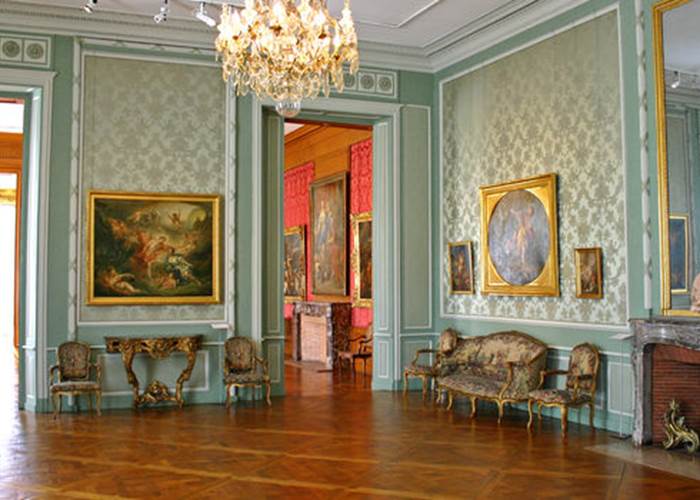
Museum of Fine Arts in Tours
The largest collection of Italian Primitives after the Louvre!
A short walk from the cathedral, the former archbishop's palace, a listed historical monument, houses the collections of the Museum of Fine Arts.
The former archbishop's palace, built in 1767, is a large classical building with a pediment and attic, and a terrace to the east overlooking the gardens and park. This understated architecture preserves traces of earlier buildings that stood on the site from Antiquity to the 18th century. Gallo-Roman rampart and tower (4th century), remains of the church of Saint Gervais – Saint Protais (4th-12th centuries).The Halls of the Estates (12th-18th centuries), a former 17th-century palace, offer numerous architectural lessons. The final alterations were made on the eve of the Revolution: the entrance courtyard was enclosed by a semi-circle preceded by a monumental gate forming a triumphal arch, while the former Hall of the Estates was transformed into a chapel with an antique-style colonnade.
After 1789, the Archbishop's Palace became a theater, a central school, a library, and a repository for confiscated works of art. Under the Empire and throughout the 19th century, the buildings were once again used by the archbishopric. It was only in 1910, when the city acquired the property, that the collections were returned to the former archbishop's palace.
The museum's oldest collection consists of works seized in 1794 from the homes of émigrés, churches, and convents, particularly the great abbeys of Marmoutier, Bourgueil, and La Riche, as well as paintings and furniture from the Château de Chanteloup and Richelieu. Among the most famous artists are Blanchard, Boucher, Boulogne, Houël, La Fosse, Lamy, Le Sueur, Parrocel, and Restout.
Officially established in 1801 by the consular decree that marked the creation of fifteen major provincial museums, the museum benefited from a loan of thirty exceptional paintings from the Muséum Central, the future Louvre, including a series of reception pieces from the Royal Academy of Painting. It was at this time that the Museum of Fine Arts in Tours received Rubens' Ex-voto and the masterpieces of the Italian Renaissance, namely the two panels by Andrea Mantegna.
During the 19th century, the city of Tours acquired two significant collections of paintings, well represented in the 18th-century French and Italian periods. State deposits, bequests, and donations enriched the museum throughout the 19th and 20th centuries with furniture, paintings, and objets d'art from various eras, expanding the collections with works by Champaigne, Corneille, Coypel, Lagrenée, Nattier, Perronneau, and Rembrandt.
In 1963, the museum received the collection of the painter and collector Octave Linet, thus creating one of the largest collections of Italian Primitives after the Louvre Museum and the Petit Palais Museum in Avignon.
The 19th century is also well represented, from the Neoclassical school (Suvée, Taillasson), Romanticism (Vinchon), Orientalism (Belly, Chassériau, Delacroix), and Realism (Bastien-Lepage, Cazin, Gervex). Impressionism, Post-Impressionism, and Symbolism are present through the works of Monet, Degas, Henri Martin, and Le Sidaner.
The collection of 20th century works includes Asse, Besse, Briggs, Calder, Davidson, Debré, Denis, Peinado, Zao Wou-ki.
A place for discovering and disseminating culture, the Museum of Fine Arts in Tours offers a wide choice of routes: permanent collections, temporary exhibitions, conferences, concerts, library, documentation as well as an educational service for schools.
Rich in history, architecture, and its exceptional collection, the Museum of Fine Arts in Tours is among the most important in France. Opening onto a French-style garden and shaded by a cedar tree classified as a "Remarkable Tree of France," the museum combines the charm of a palace with the beauty of a collection.